Monday, 11 May, 2026

12:55 am [NEPAL, GMT+5:45]

Admin

133 Posts
05. Outside Broadcasting and Links

05. Outside Broadcasting and Links

5.1 Remote Broadcasting Remote broadcasting covers production in, or acquisition of program material from locations away from the studio center. News is an important part of radio and television broadcasting, and television, in particular, relies greatly on production that takes place outside the studio, for sports, music events, and drama production. Bringing outdoor events into the living room of the viewer is becoming more and more common. In order to record these events, the outside broadcast or OB vehicle with communication link is used. Remote broadcasting can be categorized, normally, in two ways: 1. Remote News Gathering and 2. Remote…
Read More
Mutiple Access

Mutiple Access

A limited amount of bandwidth is allocated in wireless services. A wireless system is required to accommodate as many user as possible by effectively sharing the limited bandwidth. Therefore in the field of communications, multiple access could be defined as means of allowing multiple user. To share the finite bandwidth simultaneously.There are 4 basis schemes for this 1] Frequency Division Multiple Access (FDMA) 2] Time Division Multiple Access (TDMA) 3] Code Division Multiple Access (CDMA) 4] Space Division Multiple Access (SDMA)
Read More
Wave Division Multiplexing (WDM)

Wave Division Multiplexing (WDM)

- WDM is analog multiplexing technique. - It's working is same as  FM. - In WDM different signals are from optical fibers. - Various light waves from different source combined to form a composite light signal that is transmitted across the channel to receive. - At the receive side the composite signal light signed is broken into different light waves by demultiplexing. - This combining and splitting of light wave is done by using prism.
Read More
Frequency Division Multiplexing (FDM)

Frequency Division Multiplexing (FDM)

- It is an analog technique. - Signals of different frequencies are combined into a composite signal and is transmitted on the signal link. - Bandwidth of link should be greater than the combined bandwidth of various channels. - Each signals have different frequencies. - Channels are separated by strip of unused bandwidth called Guard bands to prevent from overlapping.Application: - FDM is used for FM and AM radio broadcasting. - FDM is used for television broadcasting. - First generation telephone also use FDM.
Read More
Time Division Multiplexing (TDM)

Time Division Multiplexing (TDM)

    - It is digital multiplexing technique. - Channel is not divided on the basis of frequency but on the basis of time. - Total time available in channel is divided between several users. - Each users is allocated to particular time interval called time slot. Types of  TDM 1] Synchronous TDM 2] Asynchronous TDM 1] Synchronous TDM Number of Input = 5 Number of Slot in frame = 5 - Each device is given some time slot to transmit the data over the link whether the device has any data to transmit or not. - Each device place its…
Read More
Multiplexing and Multiple Access

Multiplexing and Multiple Access

Multiplexing: Multiplexing is a method by which multiple analog signal or digital data streams are combined into one signal over a shared medium. The aim is to share expensive resource. For eg. in telecommunication, several telephone calls may be carried using one wire. A device that performs the multiplexing is called multiplexer (MUX) and the device that performs the reverse process is called de-multiplexer. Fig. Multiplexer and De-multiplexer
Read More
Vectors and Scalars:

Vectors and Scalars:

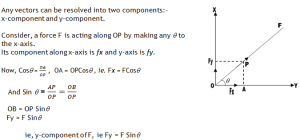
Those physical quantities which have only magnitude but no direction are called scalars. For eg. Mass, Speed, Distance, Work, Energy, Charge, Current etc.   Those physical quantities which have both magnitude and direction are called vectors. For eg. Displacement, Force, Velocity, Acceleration, Linear Momentum etc.   Vectors are generally represented by a letter with arrow head.       Types of Vectors: i]   Unit Vector      A vector is said to be a unit vector if its magnitude is one.         ii]  Null Vector      If the magnitude of a vector is zero, the…
Read More
1.3 Radical

1.3 Radical

An atom or group of atoms which bears charge and behaves as single unit during chemical reaction is called radical. Eg. SO4--, Ca++ etc. Depending on charges present, radicals are classified as below:- Electropositive Radical (Basic Radical) (Cation):- These radicals possess positive charge and collect at cathode during electrolysis. Eg. NH4+, Ca++, Zn++ etc. Electronegative Radicals (Acid Radical/Anion):- These radicals possess negative charge and collect at anode during electrolysis. Eg. SO4--, Cl-, NO3- etc. Depending on constituent atoms radicals are classified as below:- i] Simple Radical This type of radicals contains only one type of atoms that can be one…
Read More
1.2 Valency

1.2 Valency

Valency: Valency is the combining capacity of an element with other elements. In electronic concept, valency is the number of electrons gained or lost or shared by an atom of an element during chemical reaction. Valency of an element depends on the number of valence electrons present in an element. Variable Valency: Some elements can show two or more than two different valencies while forming different compounds. These different valencies are due to the participation of different number of electrons while forming compounds. Such different valencies are called variable valencies.  
Read More
No widgets found. Go to Widget page and add the widget in Offcanvas Sidebar Widget Area.